
What About The Claims About Reduced Disease Risk From Paleo Diets? Are They True? by Brenda Davis, R.D.
Brenda Davis offers fresh insights on the treatment of animals in food production and other industries, the latest findings on the health benefits of a vegan diet and expanded the information on phytochemicals, Brenda’s information is extensive in scope, yet manageable for anyone who wants to easily understand how to construct a nutritionally balanced plant-based diet.
Here are the latest findings on: using plant foods to protect against cancer, heart disease, and other chronic illnesses; obtaining essential protein without meat, eggs, or dairy products; discovering “good” fats and where to find them; meeting dietary needs for calcium without dairy products; understanding the importance of vitamin B12; designing balanced vegan diets for infants, children, and seniors; and making the most of vegan pregnancy and breastfeeding.
This is a sound blueprint to follow for better health for yourself and the planet.
Connect with The Real Truth About Health
http://www.therealtruthabouthealth.com/
Passionate believers in whole food plant based diets, no chemicals, minimal pharmaceutical drugs, no GMO’s. Fighting to stop climate change and extinction.
Intro
[Music]
and what about the claims about reduced
Reduced Disease Risk?
and what about the claims about reduced disease risk because we have all sorts of little trials that show reduce body weight increase satiety improved lipid profiles improved blood glucose better insulin sensitivity less inflammation decreased blood pressure in people going paleo versus people eating western-style diets
so why are we seeing these favorable results well we’re seeing the favorable results because the Paleo diet of today removes refined grains refined sugars refined fats and oils or they’re supposed to fast foods fried foods processed meats high-fat dairy and alcohol that’s what they remove in these studies and so of course you’re going to get some improvements compared to a Western diet
Short Term Gain; Long Term Pain?
however is it really short term gain for long term pain and this is something I would argue while many paleo diets do induce weight loss and favourable lab results in the short term they’re really significant concerns about adopting such diets in the long
Paleo = High Meat Diets
term paleo diets are high meat diets that’s what they are they’re high in animal protein they’re high in agro chemicals they’re high in carnitine which is converted to TMAO by gut bacteria which is highly atherogenic they’re high in endotoxins which is the outer cell membrane of gram-negative bacteria that can cause that can leak into the bloodstream and be very inflammatory they’re high in environmental contaminants all the persistent organic pollutants they’re high in heme iron which is a pro-oxidant they’re high in nu v GC which is a pro-inflammatory molecule and nitrosamine Ziff they’re processed they’re high in products of oxidation they’re high in saturated fat and cholesterol and they cause an upregulation of cancer promoting genes so that’s what we’re doing when we boost
How Much Meat?
meat intake how much meat are people eating paleo actually consuming well the typical recommendations are for 30% protein so in a 2,000 calorie diet that’s a hundred and fifty grams of protein in a 2800 calorie diet it’s 210 in grams of protein so assuming that 80% of their protein comes from meat and 20% from plants we’re talking about 16 to 22 ounces of meat a day 16 to 22 ounces
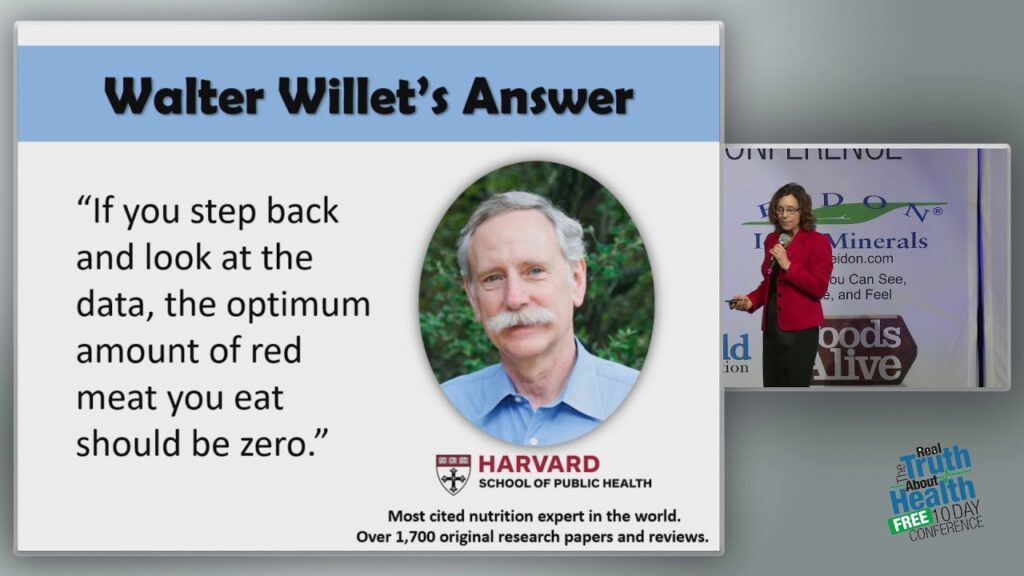
how much meat is actually safe to eat well according to the most cited
Walter Willet’s Answer
nutrition expert in the world dr. Walter Willett from Harvard if you step back and look at the data the optimum amount of red meat you should eat you eat should be 0 in 2016
the Mayo Clinic put out a study a analysis of six studies six studies with over 3 million participants they said there was strong consistent evidence that increased intake of red meat especially processed red meat is associated with increased all-cause
Red Meat and Mortality
mortality and we see that in meta-analysis after meta-analysis red meat is consistently linked with all cause mortality with cardiovascular disease with cancer and with diabetes and in 2015 the World Health Organization actually declared processed meat a group one human carcinogen and red meat a group to a or probable human carcinogen a group one human carcinogen is in the same category as cigarettes and asbestos so this we know
so let’s talk about plant-based versus paleo keto diets briefly we have very clear consistent evidence that whole plant foods are protective to health heavily processed foods fast foods fried foods with added fat sugar and salt are damaging to health and meat especially processed meat increases risk of disease we know that
National and International Dietary Guidelines
and because we know that national and international dietary guidelines are starting to reflect this reality what you need to understand is these diets are taking out some of the most protective foods on the planet foods that are consistently associated with disease risk reduction
the evidence is so strong for that now that national and international dietary guidelines are starting to reflect this the World Health Organization in the 12 steps to healthy eating step number one is to eat a nutritious diet based on a variety of foods originating mainly from plants rather than from animals number one the FAO the Food and Agricultural organization in plates pyramids and planets they they highlighted international leaders that are large that are promoting largely plant-based diets because they have advantages for health and the planet in Germany choose mostly plant-based foods in Brazil eat foods mainly of plant origin in Qatar emphasize a plant-based diet in the UK eat more plant-based foods we’re seeing this over and over and over again
Cancer Organizations
cancer organisation eat a healthy diet this is the American Cancer Society with an emphasis on plant foods and and the World Cancer Research Fund eat mostly foods of plant origin the American Institute of cancer research chews mostly plant foods such as vegetables fruits whole grains and cut sugary drinks
Dietary Guidelines for Americans Scientific Advisory Committee 2015
we look at the Dietary Guidelines for Americans scientific advisory committee in 2015 they say that a dietary pattern that is higher in plant-based foods such as vegetables fruits whole grains legumes nuts and seeds and lower in animal-based foods is more health promoting and is associated with lesser environmental impact than the current u.s. diet
then we see this brand-new eat Lancet Commission from 2019 and they basically say Universal healthy reference diet is one that increases the fruits vegetables our vegetables fruits whole grains legumes nuts and seeds and decreases unhealthy foods like red meat sugar and refined grains so this is Universal and now in Canada’s Food Guide 2019 Canada I’m for I’m a Canadian and I was rejoicing very recently we put out our new food guide and our new food guide is reflecting this knowledge as well we did not listen alright allow input from industry on this food guide and so the guide is mostly Platts half the plate vegetables and fruits 1/4 the plate whole grains a quarter of the plate of protein sources whether that be beans nuts and seeds or some animal products dairy is nowhere to be seen except for as part of the protein group