Just because time is tight, it doesn’t mean we have to sacrifice nutrition or flavor in our meals. With a little planning and creativity, you will find that making easy, healthy, plant-based meals is a breeze. The bottom line is “fast foods” do not have to be unhealthy!
10 Simple Steps to Stress-Free Plant-based Meals
Here is a 10-step guide to helping you put together delicious, healthful meals that kids and adults alike will enjoy!
- Plan your meals. When you plan your meals for the week, you don’t have to panic about what’s for dinner. Purchase the necessary ingredients and you will be good to go. When you know what’s for supper, you reduce the risk of making less healthful spur-of-the-moment choices.
- Stock your kitchen. Make sure to stock up on essential plant-based ingredients such as whole grains (intact grains, bread, pasta, and crackers), legumes (dried and canned), other plant-based proteins (tofu, tempeh, seitan, soy curls, etc.), vegetables (fresh and frozen), nuts, and seeds.
- Batch prepare staples. Preparing staples in advance can make lunch and dinner preparation a breeze. Starchy staples and legumes can be used on salads, in dinner bowls, and to make a variety of main dishes.
- Always have a starchy staple pre-cooked. This can be whole grains such as quinoa, black rice, or barley, or a starchy vegetable such as baked sweet potatoes.
- Make a big pot of beans, lentils, or chickpeas to last the week.
- Prepare breakfast grains in advance. For example, cook oat groats and quinoa, and add nondairy milk, dried prunes, and spices. Refrigerate and enjoy hot or cold for several days.
- Make a salad large enough to last 3–4 days. Use greens and nonstarchy vegetables that will not discolor or go soft. Add perishable items just before serving.
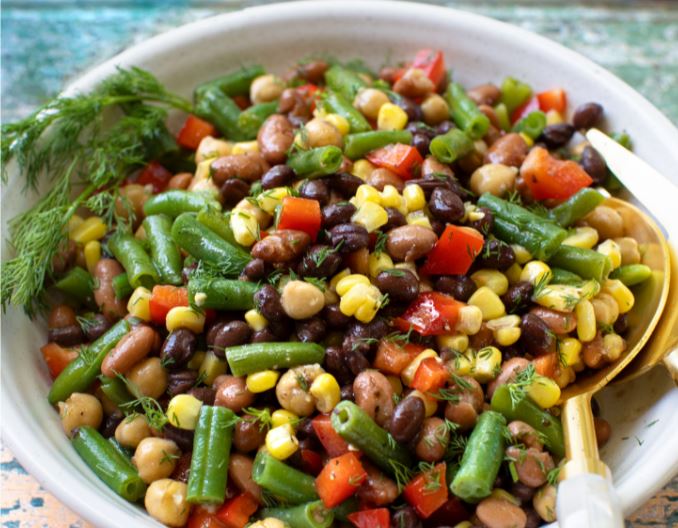
- Make a bean salad that can last several days.
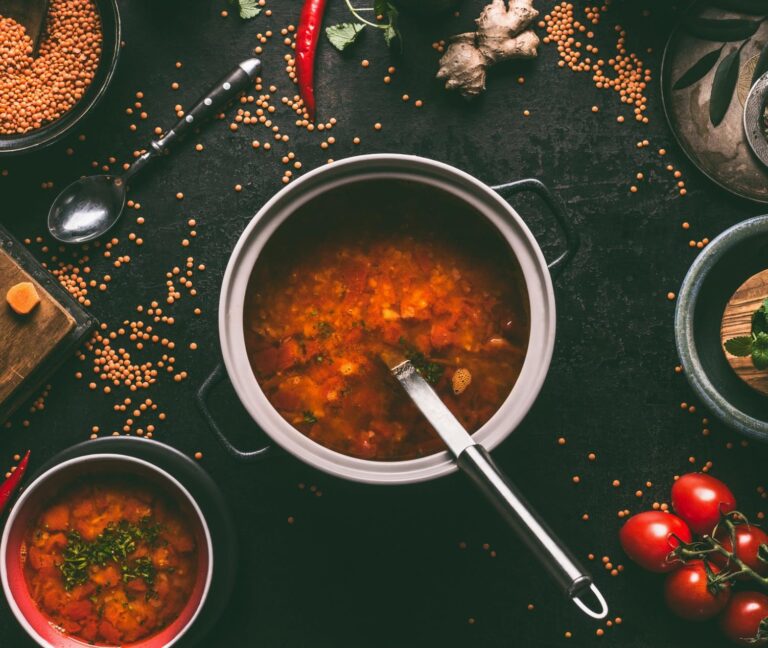
- Make large batches of soup or chili.
- Make enough salad dressing or peanut sauce to last several meals. Some dressings make excellent sauces for dinner bowls.
- Double or triple recipes. It doesn’t take much extra work to double or even triple a recipe. You can enjoy leftovers for lunch, another dinner, or simply freeze them to use when you are really pressed for time.
- Buy some pre-prepped food. There is no shame in taking a few shortcuts when you are pressed for time. Buy triple-washed salad greens, pre-cut veggies, grated carrots, or peeled and cut pineapple.
- Use a slow cooker or Instant Pot to make one-pot meals. Cooking couldn’t be much easier than throwing everything into one appliance and pressing a button. Slow cookers are great if you want to put dinner on before leaving for work, and Instant Pots are marvelous for quick one-pot meals.
- Keep spices handy and use liberally. Keep herbs and spices close at hand as they can add life to even the simplest meal. Pre-made spice blends can help make seasoning simple.
- Use your freezer. Keep a variety of bagged legumes (e.g., edamame or green chickpeas), vegetables (e.g., spinach, broccoli, corn, and peas), fruits (e.g., berries, mango, pineapple), breads (e.g., whole-grain breads, rolls, and flatbreads), and treats (e.g., homemade muffins and cookies) in the freezer.
- Re-purpose leftovers. You can turn most leftovers into soups or add them to salads. Leftover beans can be used in tacos, spreads, or curries. Leftover grains can be used to make a pilaf or the base of a dinner bowl.
- Use kitchen equipment. Food processors, choppers, good knives, good cutting boards, mixers, and blenders can all make food prep so much easier. One of my favorite tools is a mini food processor with a pull string. It makes cutting onions quick and tearless.
A Dozen Quick and Easy Family Favorites
- Stir-fries – Toss tofu or tempeh with vegetables and a flavorful sauce. Serve with whatever grain you have on hand.
- Bowls – Start with a cooked grain. Add steamed veggies, beans, baked tofu or tempeh, and a delicious dressing. Throw on a few sprouts and nuts or seeds.
- Pasta – Make a pasta dish with whole grain or legume-based pasta and tomato, cashew cheese, or pesto sauce, and veggies or salad.
- Veggie burgers – Veggie burgers are a fun meal for everyone. Serve with a whole grain bun, all the fixings, and a green salad.
- Tacos – Have a taco night. You might like to get both hard and soft tacos so everyone gets their pick. Heat up some mashed black or pinto beans, and add lettuce, tomatoes, and grated carrots. Top with guacamole and salsa.
- Wraps or sandwiches – Fill whole-grain wraps or make a sandwich with hummus, smoked tofu, roasted veggies, and greens.
- Full meal salads – Start with a mixed green salad with loads of colorful veggies. Add a starch such as cubed sweet potatoes or quinoa, a protein such as baked tofu or beans, and top with nuts, seeds, and a great dressing.
- Stuffed potatoes – Bake potatoes or sweet potatoes, split, and stuff with black beans, corn, and salsa. Top with avocado slices and lime juice.
- Soup and bread – Enjoy a bean- or lentil-based soup with lots of veggies and a thick slice of crusty whole-grain bread.
- One-pot meals – One-pot meals such as stews and curries can be loaded with legumes, colorful veggies, grains, herbs, and spices.
- Pancakes or crepes – Pancakes or crepes can be topped with nut butter, bananas, and blueberry sauce, or a creamy vegetable filling. Our family favorite is lentil crepes made with soaked lentils and water (and an optional pinch of salt). You can get creative by adding veggies or greens, or soaked grains such as quinoa or rice.
- Smoothie bowls – There is no faster meal than a smoothie bowl. Throw a bunch of greens, vegetables, hemp seeds, soy milk, frozen peas, and frozen fruit into a blender. Make the smoothie so thick it needs to be eaten with a spoon. Pour into a bowl and top with fruit, nuts, seeds, and granola. Yum! Below you will find three of my quick and easy favorites – Easy Peasy Chili, Green Smoothie Bowl, and Full of Beans Salad (which I enjoy over a green salad).
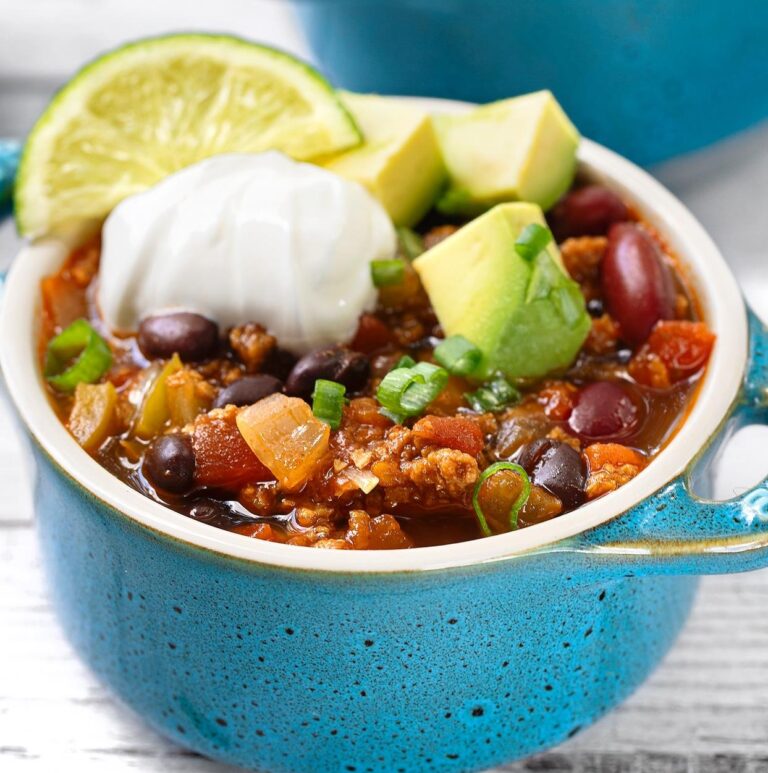
Easy Peasy Chili
Yield: 8 cups (4 L), 6 servings
This simple chili is from Plant-Powered Protein (Davis, Melina and Davis, Healthy Living Publications 2023). It is meat-free (sin carne) and flavor-full. If you like a spicy chili, add one or more finely diced hot peppers or hot sauce. Veggie
crumbles usually come in 10 to 12-ounce packages. Use whatever size you purchase! If you prefer not to use veggie crumbles, replace with one more can of kidney, black or pinto beans (or another 1 ½ cups cooked beans). Boost the
veggies by adding one cup of frozen corn, one small, chopped zucchini, or 1 ½ cups sweet potato cubes (cut in small 3/4” cubes) at the same time as the veggie crumbles.
- ½ cup vegetable stock or water
- 1 onion, diced
- 2 cloves garlic, minced
- 1 green pepper, diced
- 10 oz package veggie crumbles (burger replacement)
- 28 oz canned diced tomatoes (or 4 cups/1 L chopped fresh tomatoes)
- 1 cup mild, medium, or hot salsa
- 15 oz canned kidney beans, rinsed and drained (or 1½ cups/375 ml cooked beans)
- 15 oz canned pinto or black beans, rinsed and drained (or 1½ cups/375 ml cooked beans)
- 1 teaspoon chili powder, or more to taste
- ½ teaspoon cumin
- 1 teaspoon oregano
Optional toppings: avocado cubes, thinly sliced green onion, chopped cilantro, shredded veggie cheese, veggie sour cream, lime wedges Place stock, onion, garlic, and peppers in a large saucepan, and cook on medium heat for 10 minutes or until vegetables are tender. Add veggie crumbles, tomatoes, salsa, kidney beans, pinto beans, chili powder, cumin, and oregano. Cook another 5 minutes until heated through, then lower heat, cover, and simmer for 45 minutes (or longer, if desired), stirring occasionally. Add another ½ cup (125ml) or more of water if it gets too dry. Serve hot with optional toppings of your choice.
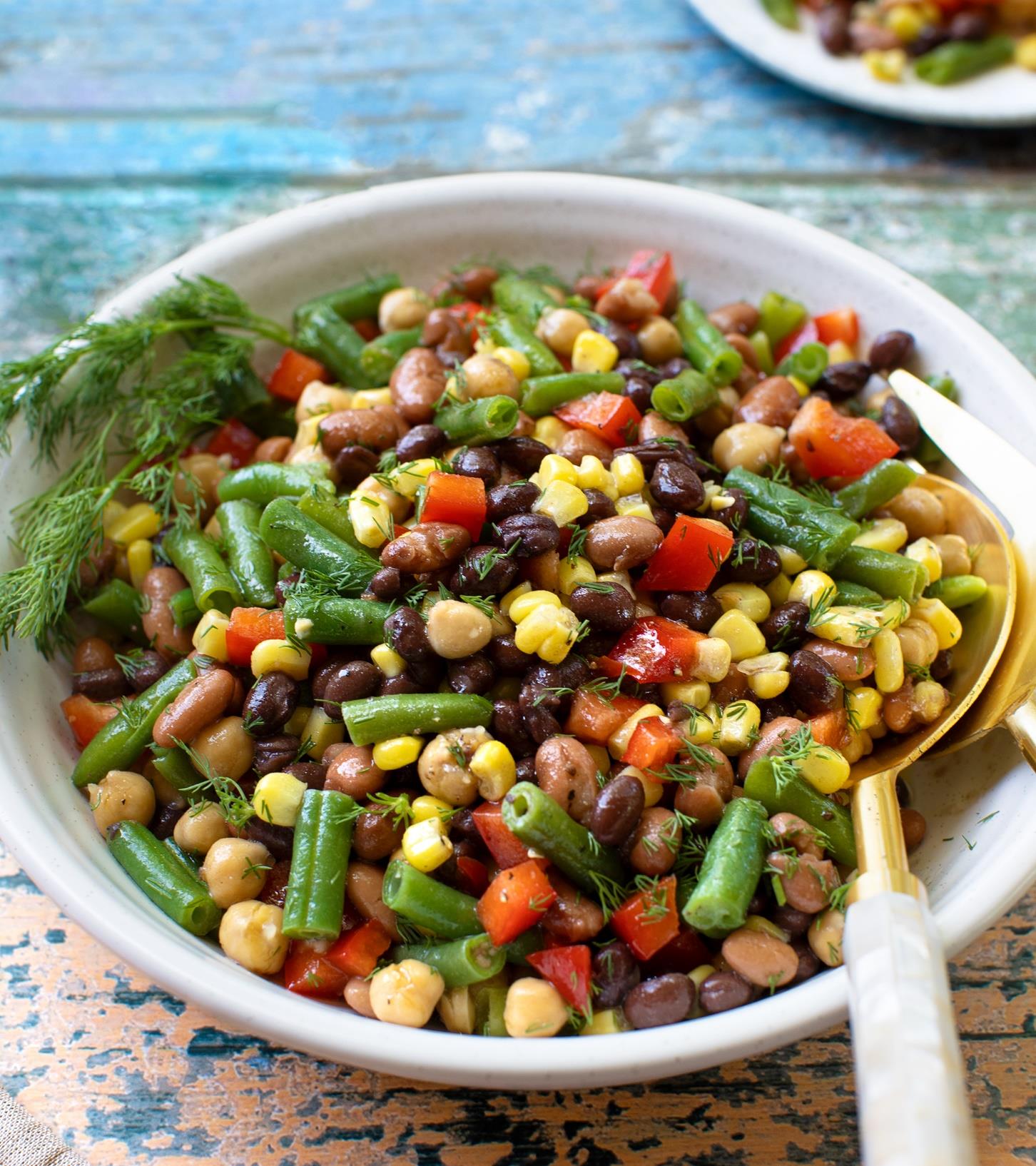
Full of Beans Salad
Makes 5 cups (1.25 L)
This bean salad is adapted from Plant-Powered Protein (Davis, Melina and Davis, Healthy Living Publications 2023). The original version contains 2 Tbsp olive oil, but it is optional and was left out of this oil-free recipe. For this colorful salad,
experiment with a variety of cooked or canned beans such as black, cannellini, edamame, garbanzo/chickpeas, lima, navy, pinto, red; include two or more types. Feel free to increase the amount or variety of vegetables in this salad. Swap the
red pepper and corn for other vegetables such as steamed asparagus, broccoli, cauliflower or green beans, cherry tomatoes, thinly sliced greens, or snow peas.
Marinade
- ¼ cup lime juice, lemon juice, or a favorite vinegar
- 3 tablespoons fresh dill or cilantro, or 1 tablespoon dried dill or cilantro
- 2 teaspoons maple syrup (optional)
- 2 teaspoons Dijon mustard
- 1 teaspoon minced garlic or ⅓ teaspoon garlic powder
- ¼ teaspoon each of pepper and salt, or to taste
Beans
- 3 cups cooked or canned beans, rinsed and drained
Vegetables
- 1 cup chopped red bell pepper
- 1 cup corn niblets, frozen and thawed or canned and drained
- In a small jar with a lid, place the lime juice, maple syrup, dill, garlic, mustard, pepper, and salt. Shake well to combine.
- Place the beans and vegetables in a large bowl. Add the marinade and gently toss. Refrigerate for several hours to marinate, stirring occasionally. Adjust seasoning to taste.
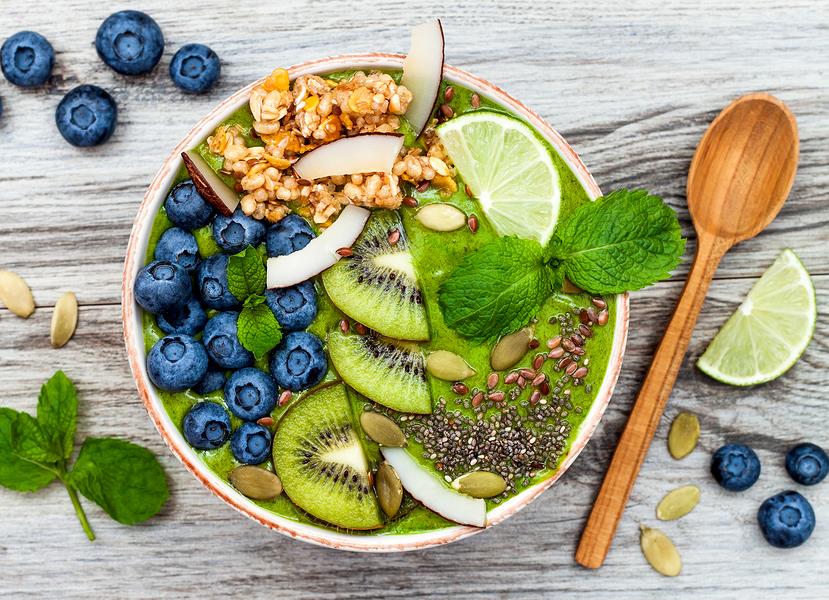
Smart Start Smoothie Bowl
Makes 2 big smoothie bowls
This recipe is from Nourish (Shah, Davis, HCI Books, 2020). Smoothie bowls can add a little fun to breakfast, or any meal. Each person can decorate their own bowl. Frozen peas may seem like an odd addition, but they add fiber, protein, and
a gorgeous bright green color. Hempseeds provide an additional protein and omega-3 boost. Frozen ingredients are the key to thick, rich-tasting smoothie bowls – make sure all other ingredients are very cold. Be creative with the
smoothie ingredients (add a carrot, a few slices of cucumber, some nut butter, soft tofu, or plant protein powder). You can omit the peas or the avocado if you don’t like them in the smoothie bowl. To turn the smoothie bowl into a smoothie,
increase the milk to 2 to 2 ½ cups (depending on how thick you like it). If you do not have a high-speed blender, this will work in a food processor. A regular blender is fine for the smoothie, but most will struggle with the thicker smoothie
bowl. If you have extra, use it to make popsicles.
Smoothie
- 3 cups greens (e.g., kale, power greens, spinach, sunflower sprouts, etc.)
- 1½ cups unsweetened fortified soy milk (or other non-dairy milk)
- 2 tablespoons hemp seeds
- 2 tablespoons pumpkin seeds
- ¾ cup frozen peas
- 2 frozen, sliced bananas
- 1 cup frozen kiwi, pineapple, or mango chunks
Toppings
- Seeds (e.g., chia, ground flax, pumpkin, sunflower)
- Nuts, chopped or whole (e.g., almonds, cashews, pecans, walnuts)
- Shredded coconut, unsweetened
- Granola
- Fresh berries
Chopped fruit (kiwi, peaches, nectarines, pineapple, etc.)
- Put ingredients in the order listed (always best to have the fresh ingredients
at the bottom and the frozen ingredients on top) into a high-speed blender
and blend on low speed, increasing speed slowly. Blend until smooth and
creamy. - Divide into 2 or 3 bowls. Decorate with rows of toppings side by side or
create your own design.
This article was written for a PCRM Food for Life Instructors group called So Many Cooks in the Kitchen. This group meets online to provide amazing cooking and nutrition demonstrations that are free to share globally. For wonderful whole food, plant-based cooking shows, tune in to their monthly broadcasts. https://somanycooks.com/about/


