
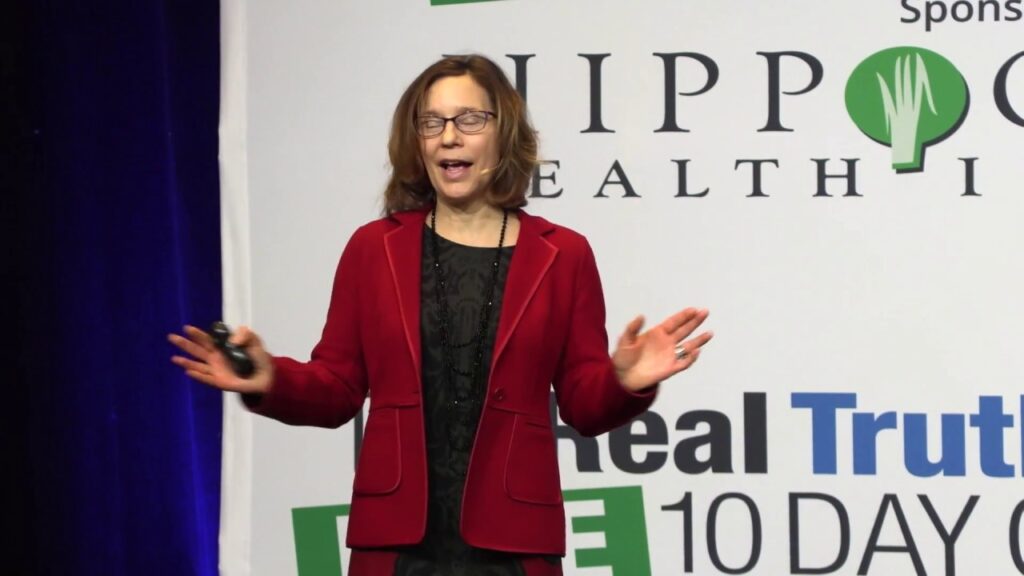
Brenda Davis, R.D. weighs the pros and cons of a whole food diet vs the paleo diet and why the paleo diet gains popularity over other alternatives.
Internationally acclaimed dietitian Brenda Davis explores the health benefits of vegan diets compared to other dietary choices; explains protein and amino acid requirements at various stages of life; describes fats and essential fatty acids and their value in plant-based diets; investigates carbohydrate facts and fallacies; reveals the truth about wheat, gluten, and grains; pinpoints where to obtain calcium, iron, zinc and other minerals without animal products; clarifies the importance of obtaining vitamin B12; and shows how to attain optimal nutrition during pregnancy and lactation and how to achieve and maintain healthy weights and exceptional fitness on a vegan diet.While much of the emphasis is on the health advantages that vegan diets offer. Plant-based nutrition truly benefits the entire planet, and every bite makes a difference.
Brenda Davis, registered dietitian and nutritionist, is a leader in her field and an internationally acclaimed speaker. She has worked as a public health nutritionist, clinical nutrition specialist, nutrition consultant and academic nutrition instructor. She is currently on a diabetes intervention research project in Majuro, Marshall Islands. Brenda spent 8 months in Majuro in 2006 and returns for 4-6 week periods every year or two. Brenda is a past chair of the Vegetarian Nutrition Dietetic Practice Group of the American Dietetic Association. In July 2007, she was inducted into the Vegetarian Hall of Fame. A co-author of nine books – award winners, Becoming Vegan: Comprehensive Edition(2014) and Becoming Vegan: Express Edition (2013), and the best-sellers, Becoming Vegan (2000), Becoming Vegetarian (1994, 1995), The New Becoming Vegetarian (2003) and Defeating Diabetes (2003), Dairy-free and Delicious (2001)and Becoming Raw (2010) and Raw-food Revolution Diet (2008). Brenda lives in Kelowna, British Columbia with her husband Paul. She has two grown children, Leena and Cory.
Connect with The Real Truth About Health
http://www.therealtruthabouthealth.com/
Passionate believers in whole food plant based diets, no chemicals, minimal pharmaceutical drugs, no GMO’s. Fighting to stop climate change and extinction.
Intro
so Kim new paleo diets ever equal true paleo diets well it would be difficult if not impossible to recreate a true Paleolithic diet but to bring new paleo diets closer nutritionally they would have to increase high-fiber nutrient-dense plant foods including vegetables fruits and and berries they would need to include more fiber rich starchy foods to get the carbohydrates up and the fat down like legumes intact whole grains and starchy vegetables and they would need to eliminate processed meat and eat less meat that’s what they would need to do but even if true Paleolithic diets were optimal for human health and we could effectively recreate a Paleolithic diet a diet is really only as good for the human species as it is ecologically sustainable and ethically justifiable paleo diets downplay the ecological crisis that makes eating lower on the food chain an ecological imperative during the
Ecological Crisis
entire Paleolithic period the human population grew from an estimated 1/2 million people to about 6 million people today we have over 7 billion in getting close to 8 billion people on this planet by 2050 it will be well over 9 billion people if
The Math
we all ate paleo and I didn’t do the math on this one dr. David Katz did the math on this one and he said if we all ate paleo we would need an estimated 15 planet Earth’s to sustain the current population
Webber Matthews Study
there was a study done in 2008 by Webber and Matthews and they said that in this study eating a hundred percent plant-based diet just one day a week reduces greenhouse gas emissions more than eating a hundred percent local seven days a week 24/7 the United Nations environmental
UN Panel
expert panel concluded two activities have a disproportionately large effect on the planet’s life-support systems number one animal agriculture number two the use of fossil fuels their recommendation a global shift to a plant-based diet the National Academy of
Fossil Fuels
Sciences in 2016 said that by 2050 greenhouse gas emissions would be reduced by twenty nine percent if everyone on the planet followed the recommended the global dietary recommendations to eat more fruits and vegetables and less meat sugar and calories but it would be reduced by 70% if we all ate vegan their recommendation a global shift to a plant-based diet well what about eating just just eating
Free Range Meat
free-range well most paleo eaters promote the consumption of free-range grass-fed animals meat from these animals is more expensive it’s not always available especially if you’re eating at a restaurant but even if you did eat completely completely free-range this is what a lot of paleo folks don’t know look at we’re here we have what we basically have is the kilograms of co2 per kilogram of food produced and the very top of this list is what grazing beef free-range beef has the highest carbon footprint of any meat then we’ve got sheep Meadow beef and feedlot beef being even lower then we’ve got seafood pork agriculture seafood chicken and eggs and at the bottom of the list we’ve got meat substitutes beans peas and soy almost nothing by comparison you know and I
Carbon Footprint
think I told this story before but I’m gonna tell it again since I have time when my son was in university in environmental sciences during his fourth year his professor had all of the students in the class calculate their carbon footprint and he he phoned me right after class and said you’re never gonna guess what we had to calculate our carbon footprint and my carbon footprint was less than half of anyone else in the class I had by far the lowest carbon footprint and he said everybody was so mad because they ride their bikes and take two minutes hours and do all of these things and I’m driving harder to school and my carbon footprint was still less than half theirs and and they all said to the professor but why Sir why and he said read my lips he doesn’t eat meat and that’s why so we’re starting to get it you know if our entire population ate a paleo diet our planet’s dwindling resources would very quickly run dry if everyone ate a plant-based diet the global calorie supply would increase by 50% which some say could effectively wipe out hunger and the paleo founders concur Boyd Eaton and Melvin Conner are the founding fathers of the current Paleo diet movement much of the essential foundation of the movement is based on their research will not anti meat they agree that eight billion people cannot eat a meat-based diet without sacrificing the planet their advice eat less meat get most of your protein from plants paleo diets are also
Ethical Issues
disregard the ethical issues associated with an increased demand for meat 70 billion land animals are slaughtered for food every year most are raised in Capo’s concentrated animal feeding operations paleo diets increase the demand for meat and they increase animal suffering and for those of you that aren’t aware I just want to tell
Pigs
you just a tiny little bit about this most of the animals in that 70 billion are our poultry our chickens and every animal is an individual and the animal I offer I like to talk about because I think people can relate to this animal more are pigs I like to talk about pigs because a pigs have a lot in common with dogs in terms of intelligence dogs there were there was a study done in California that rated dogs at about a two and a half year old child the intelligence of a two and a half year old child they rated pigs at a three-year-old child and as a matter of fact I was just astounded when I read what they were doing research-wise they taught pigs to use a joystick on a computer and they had a game for them that they had to match up shapes on each side of the computer and if they match the shape correctly they got a treat coming out of this little funnel and the researcher said there was no pig that ever made a mistake and then the
Chimpanzees
researcher also said she couldn’t teach dogs how to do that no dogs no matter how smart they were the dogs could not learn that game and she also said we taught a chimpanzee to play the game as well and she remembers saying to the chimpanzee if you were a pig you would have had this five minutes ago and and so you know the point being that that somehow somehow someway we love animals in two categories according to how animals choose to or how humans choose to use those animals if we use the animals as pets and they are companions they are given a very very different we look at them very differently than we do animals that we consider food somehow animals we consider food we forget about their sensibilities about their intelligence about their needs and and for those of you that don’t know pigs that are raised in Kay foes we’re looking at hundreds of thousands of pigs sometimes in one facility and they each have a small space and the space is so small that they can’t even lie down pigs would live about 12 to 15 years they live six months in these facilities their life is six months when pigs are oh I don’t know I’m not an expert on this but I think it’s about three weeks of age because they go insane in these facilities because they’re smeller’s are about 200 times stronger than ours and they the the the dust and dander and stench and we have to put gas masks on when we go in because we can’t stand it their smeller’s are 200 times more powerful than ours you can imagine what it would be like that they go insane and so they try to bite one another’s tails off they’re just in this tiny little space and so what we do is cut off their tails we cut off their ears we cut off their genitals with no anesthetic whatsoever when they’re babies and and that’s that’s we have commodified animals we have turned them into meat making machines and we are so far removed from them that we forget that they’re living beings they’re feeling loving beings and and it’s so easy to forget when they’re as my friends had camouflaged in cellophane in the grocery store
Blinders
and when we look at you know I think back not so many years when my mom grew up on a farm she you know they had a few pigs and a cow and they had names for all of their animals and and yes those animals still died at the end of their lives but they actually lived quite long lives today I think people just don’t know we it’s too hard for people to take the blinders off because if you take the blinders off you can’t eat these animals anymore you just can’t it’s there’s that there’s this cognitive dissonance between what’s really going on and what we’re doing and when we know we can’t do the same anymore and in my view when we when you think about all of this there is no way humans can justify what we are doing to animals there is no justification for it it’s um you know it just makes no sense
Animals
for humans to cause such horrendous pain suffering and death in billions and billions of animals not including any of the animals from the from waters any of the fish or turtles or any of the other animals we kill when it is absolutely completely unnecessary not only is it unnecessary we’re destroying the planet we’re killing ourselves you know it it’s it’s unnecessary and it’s harmful it’s got to stop it’s just got to stop the ultimate question is not whether paleo diets can support human health but rather how humans can best adapt to their current environment to sustain a growing population on a shrinking planet that’s the ultimate question and we as
The Ultimate Question
individual human beings have a choice it makes sense to eat Whole Foods however it makes very little sense to funnel those Whole Foods to animals in an overpopulated world when we consider the consequences of our food choices not just for ourselves but beyond ourselves a plant-based diet just very simply makes sense and I want to tell you because I actually have a few
Story Time
minutes left I want to tell you a story and this is the story of my son when he was three years old this is 27 years ago I have two children one is a 33 year old daughter I have one granddaughter whose will be two in April and I have a son who’s thirty years old when he was three I can remember he used to watch you know whatever it was Sesame Street and there were commercials about McDonald’s and in the commercials there were hamburgers growing on this tree and the hamburger at the Hamburglar what he call hamburger glar or whatever he would come and steal the hamburgers off the trees the hamburger ler anyway he would come and steal the hamburgers off the trees and and I can remember driving I was driving in the car with my son and he saw a big you know golden arch sign and he said mommy can we please stop and have a McDonald’s hamburger and I thought okay now is the time I need to tell him I need to tell him the truth and so I said to him honey I said the hamburgers at McDonald’s are not the same as the hamburgers at home I said the hamburgers at McDonald’s are made of cows and he looked at me and he went like this mom people do not eat cows like it was the stupidest thing it ever heard in his entire life and he just kind of like stupid and and so and so I I didn’t say anything right away and then he said do they mommy do they and I said honey yes they do and and he had these you know little tears coming down and he looked at me and he said but mommy them have eyes he said mommy them have noses them have ears them have mouths he said don’t they know that cows are people too and and I thought to myself why is it that children get it you know they just get it and then we spend the next you know 10 20 years desensitizing them we need to remember where we came from and what we’re here for and you know I’m gonna finish the story because about two weeks later he got invited to a McDonald’s birthday party his best friend and at that time McDonald’s had pizza and so he you know I figured well it’s not vegan but at least it they had vegetarian pizza he could maybe he could just have that and so he’s in the lineup he gets to the front of the line and he says I want a hamburger with no cows inside the lady looked at him she did not know what to say so in summary avoid fatty meats eat your veggies and get your daily exercise that is the key to a long and healthy life not a paleo diet thank you thank you